QUINZE MAI, the event agency organizing the event, is ISO 20121 certified, the international standard dedicated to responsible event management.
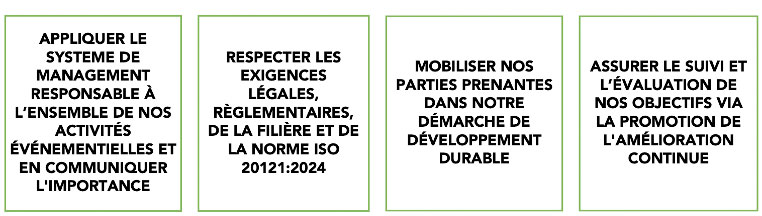
QUINZE MAI is committed to organizing all its events in a more responsible manner, to unite its clients, suppliers, service providers, and partners around its objectives, and to raise awareness among all stakeholders, while respecting the following sustainable development principles: Vigilance – Inclusion – Integrity – Transparency.
Our priority objectives
Our commitments
Actions to reduce the impact of events
For each event, we prioritize collaboration with ISO 20121 certified partners, or those committed to a sustainable development approach (e.g., local caterers with short supply chains, eco-designed and reusable stands...). Here are examples of concrete actions implemented at events to reduce their impact (non-exhaustive list):
- Implementation of selective sorting at the exhibition
- Waste recovery via partners specialized in reuse and repurposing
- Recycling of special waste such as carpet or cigarette butts (via partners)
- Reduction of aisle carpeting
- Reduction (or even elimination) of printed materials such as catalogs or pocket maps, in favor of digital
- Reduction of the number of magazines and journals on site, in favor of a digital kiosk
- Reduction of printed signage, in favor of screen-based signage
- Use of badge holders made from recycled plastic
- Specific services performed by ESATs (sheltered workshops): attaching badge holders to lanyards, inserting materials...
- Accessibility of spaces for people with reduced mobility (PRM)
- Encouragement to use public transport on various communication channels (websites, social networks, newsletters, badges)
Measuring the impact of events
QUINZE MAI strives to measure the impact of its events, with the aim of reducing it, using CLEO, a carbon footprint tool dedicated to event management.

Recommendations for exhibitors

Design and layout:
- Prefer ISO 20121 certified stand builders
- Opt for an eco-designed stand, using durable and reusable materials, as well as rented elements.
- Consider storing the stand for reuse at other events.
- Use LED bulbs for stand lighting.

Communication:
- Do not print flyers / leaflets.
- Replace printed materials with digital.
- Replace goodies with services.
- Limit the quantity of goodies distributed, and opt for relevant items made from recycled materials, or that can be recycled.
- Use existing posters or roll-ups made from recycled materials, or that can be recycled.

Audiovisual:
- Opt for rented sound and light elements.
- Favor dark-colored visuals and HD video formats not exceeding 1080x1920 pixels.

Transport and accommodation:
- Prioritize travel by train, carpooling, and public transport.
- Opt for accommodation closest to the event venue to limit travel.

On-site:
- Turn off stand lights at the end of the day.
- Sort waste according to on-site possibilities.
What is ISO 20121?
ISO 20121 was created in 2012, as part of the London Olympic and Paralympic Games. This international standard is dedicated to responsible management systems applied to event activities.
ISO 20121 is a beacon for sustainable event management, aiming to seamlessly integrate sustainability into every facet of event planning and execution. With a particular focus on environmental, social, and economic impacts, this standard is crucial for leaving a lasting positive legacy, and applies to all types and sizes of events.